


It's important to understand the significant differences between check valve API 594 API 6D standards. The check valve API 594 API 6D standards each serve unique purposes: API 594 focuses on the design, materials, and testing requirements specifically for check valves, while API 6D covers pipeline valves and emphasizes comprehensive documentation and rigorous testing procedures. These standards are essential for ensuring your system’s safety and reliable operation. Engineers often face challenges such as size limitations, pressure class requirements, and strict compliance with these standards. LIANGGU VALVE offers a wide range of check valves that fully comply with both check valve API 594 API 6D standards, making them an ideal choice for your project needs.
Key Takeaways
-
API 594 works best for check valves in process piping. It focuses on design and sealing to stop backflow.
-
API 6D covers more types of pipeline valves. It needs more testing and paperwork for safety.
-
Pick API 594 for smaller, fast-closing valves in refineries and chemical plants. Use API 6D for bigger, high-pressure pipelines.
-
Knowing the differences between these standards helps you pick the right valve for your project.
-
LIANGGU VALVE has many check valves that follow the rules. This makes it easier to find the right one for your system.
Key Differences in Check Valve Standards
API 594 vs API 6D Overview
You should know how api 594 and api 6d standards affect check valves. The American Petroleum Institute made api 594 for check valves in process piping. This standard gives rules for design, materials, and testing. Api 6d covers more types of pipeline valves, like check, gate, ball, and plug valves. Api 6d has rules for design, making, testing, and paperwork for pipeline valves. You often see api 6d in oil and gas pipelines. Api 594 check valve standards are used in refineries and chemical plants.
Tip: If you work with pipelines, you use api 6d check valve standards. If you work with process piping, api 594 is your main guide.
Main Distinctions
There are some big differences between api 594 and api 6d. Api 594 check valve standards help stop backflow in process systems. Api 6d check valve standards are for valves in high-pressure pipelines. Api 6d needs more paperwork and tougher testing. Api 594 cares about strong structure and good sealing for check valves. Api 6d also has rules for actuators and quality checks over time. You find api 6d check valve standards used for main shutoff valves in pipelines. Api 594 check valve standards work best at pump outlets and to stop backflow.
Here are some key points to remember:
-
Api 594 is for check valves in process piping.
-
Api 6d covers check valves and other valves in pipelines.
-
Api 6d needs more testing and paperwork.
-
Api 594 focuses on sealing and fast closing to stop backflow.
-
Api 6d works for bigger sizes and higher pressures.
Comparison Table
You can use this table to compare api 594 and api 6d standards. It helps you pick the right one for your project.
|
Feature |
API 594 |
API 6D |
|---|---|---|
|
Scope |
Process piping check valves |
Pipeline valves (gate, ball, plug, check) |
|
Check valve types |
Wafer dual-plate, single-plate, lug-type |
Swing, piston-lift, dual-plate, tilting disc |
|
End connections |
Wafer (between flanges), lug |
Flanged, butt-weld, wafer, compact |
|
Size range |
NPS 2 to NPS 48 |
NPS 2 to NPS 60+ |
|
Pressure classes |
150, 300, 600, 900, 1500, 2500 |
150, 300, 600, 900, 1500, 2500 |
|
Face-to-face |
API 594 tables (short pattern) |
ASME B16.10 or API 6D tables |
|
Body material |
ASME B16.34 |
ASME B16.34 or API 6D material requirements |
|
Shell test |
API 598 |
API 6D (1.5x rated pressure) |
|
Closure test |
Low-pressure air/gas (API 598) |
Low-pressure + high-pressure closure (API 6D) |
|
Fire safe |
Optional (API 607) |
Optional (API 607/6FA) |
|
Piping codes |
ASME B31.3, B31.1 |
ASME B31.4, B31.8 |
|
Typical applications |
Refinery, chemical plant, offshore topsides |
Cross-country pipelines, terminals, pump stations |
Api 594 check valve standards are for process piping and quick closing. Api 6d check valve standards are for bigger pipelines and harder tests. Use this table to choose the right standard for your project.
Application Scope: API 594 and API 6D
API 594 Scope and Uses
Api 594 is used in many fields. This standard is for check valves in process piping. You use api 594 check valve in oil and gas plants. It is also used in chemical factories, power plants, and offshore rigs. The design fits flanged, wafer, and butt-weld connections. These valves stop backflow and protect pumps and compressors. Api 594 check valve closes fast and seals well.
Here is a table showing where api 594 is used:
|
Industry |
Application Description |
|---|---|
|
Oil & Gas Industry |
Used in all parts of oil and gas work, like platforms and pipelines. |
|
Petrochemical & Chemical Plants |
Keeps dangerous chemicals from flowing backward into pumps and compressors. |
|
Power Generation |
Put in boiler feedwater and cooling water systems in power plants. |
|
Pipeline Transmission |
Makes sure oil, gas, and water flow the right way in long pipelines. |
|
Offshore Platforms |
Good for offshore rigs because it is small and light. |
You pick api 594 for refineries and many check valve jobs. The standard lets you use different valve types and connections.
API 6D Scope and Uses
Api 6d is for pipeline valves in important hydrocarbon services. You use api 6d check valve in long oil and gas pipelines. The standard fits valves up to DN 1500. It includes fire-safe and emissions features. You see api 6d in block valves at pipeline stations. It is also used in compressor, pump, metering stations, and storage terminals.
Here are common uses for api 6d check valve:
-
Long oil and gas pipelines use these valves to control flow and block sections.
-
Block valves in stations keep equipment safe in compressor, pump, and metering stations.
-
Storage terminals use api 6d valves for safety and flow control.
You pick api 6d when you need special valves for pipelines. The standard makes sure valves work well and pass tough tests.
Tip: You match check valve api 594 api 6d standards to your project needs. Api 594 is good for process piping and general industry. Api 6d is best for pipelines and moving hydrocarbons.
Valve Types and Design Features

API 594 Check Valve Types
There are different check valves in api 594. The main types are wafer, lug, and double flange. These valves fit between flanges and save space. You can pick a small design for tight spots. Many api 594 check valves use springs to close fast. This stops backflow and keeps your equipment safe.
Here is a table with api 594 check valve features:
|
Feature |
Description |
|---|---|
|
Wafer Design |
Easy to install, fits between flanges, saves space |
|
Lug Style |
Lets you mount securely, helps during maintenance |
|
Double Flange |
Strong sealing, good for high-pressure jobs |
|
Spring Mechanism |
Closes quickly, stops backflow |
|
Seat Options |
Soft or metal seats for different fluids |
|
Flow Efficiency |
Slim plate design helps flow and lowers pressure drop |
Note: You can pick api 594 check valve styles for your system. Small designs and springs help your valves work well.
API 6D Check Valve Types
Api 6d check valves come in many types. These valves are used in pipelines for oil, gas, and other fluids. Common types are swing, piston-lift, dual-plate, and tilting disc. Api 6d check valves often have flanged or butt-weld connections. You use these valves when you need strong sealing in high-pressure pipelines.
Swing check valves are good for simple flow control. Piston-lift check valves seal better in high-pressure jobs. Dual-plate and tilting disc designs close fast and lower pressure drop. Api 6d valves must pass tough tests and quality checks.
Tip: Pick api 6d check valve types for pipelines that need strong and reliable valves.
Design Differences
Api 594 and api 6d check valves look different. Api 594 uses small, wafer-style designs with springs for quick closing. These valves often have bodies without retainers to stop leaks. They have smooth seat faces and strong springs for fast action.
Api 6d check valves are bigger and heavier. They have flanged and butt-weld connections for pipelines. These valves must pass strict tests and can be fire-safe. Api 6d designs work for high-pressure and high-flow jobs.
|
Design Feature |
API 594 |
API 6D |
|---|---|---|
|
Body Style |
Small, wafer, lug, double flange |
Flanged, butt-weld, swing, piston-lift |
|
Closure Mechanism |
Spring-loaded, closes fast |
Swing, piston-lift, tilting disc |
|
Sealing |
Soft or metal seats, smooth faces |
Metal seats, fire-safe options |
|
Testing |
API 598 pressure test |
API 6D tough testing |
You choose check valve api 594 api 6d standards by looking at these design differences. Api 594 gives you small, efficient valves for process piping. Api 6d gives you strong, tested valves for pipelines.
Testing and Quality Requirements
API 594 Testing Standards
You need to test every api 594 check valve to make sure it works safely. The standard gives clear rules for pressure tests and closure tests. You must check the shell and seat for leaks. The test pressure depends on the valve material and size. For example, cast iron and ductile iron valves have different test pressures. Carbon steel and stainless steel valves use a test pressure that is 110% of the maximum allowed pressure at 100°F. You can see the main test pressures in the table below:
|
Valve Type |
Shell Test Pressure (PSI) |
|---|---|
|
Ductile Iron Class 150 |
400 |
|
Ductile Iron Class 300 |
975 |
|
Cast Iron Class 125 (NPS 2–12) |
350 |
|
Cast Iron Class 250 (NPS 2–12) |
875 |
|
Flange and Butt-Weld Steel |
Per ASME B16.34 |
You also need to check how long each test lasts. For most valves, you hold the pressure for 60 seconds. For larger valves, you test for 120 seconds. The chart below shows how shell test pressures compare for different valve types:
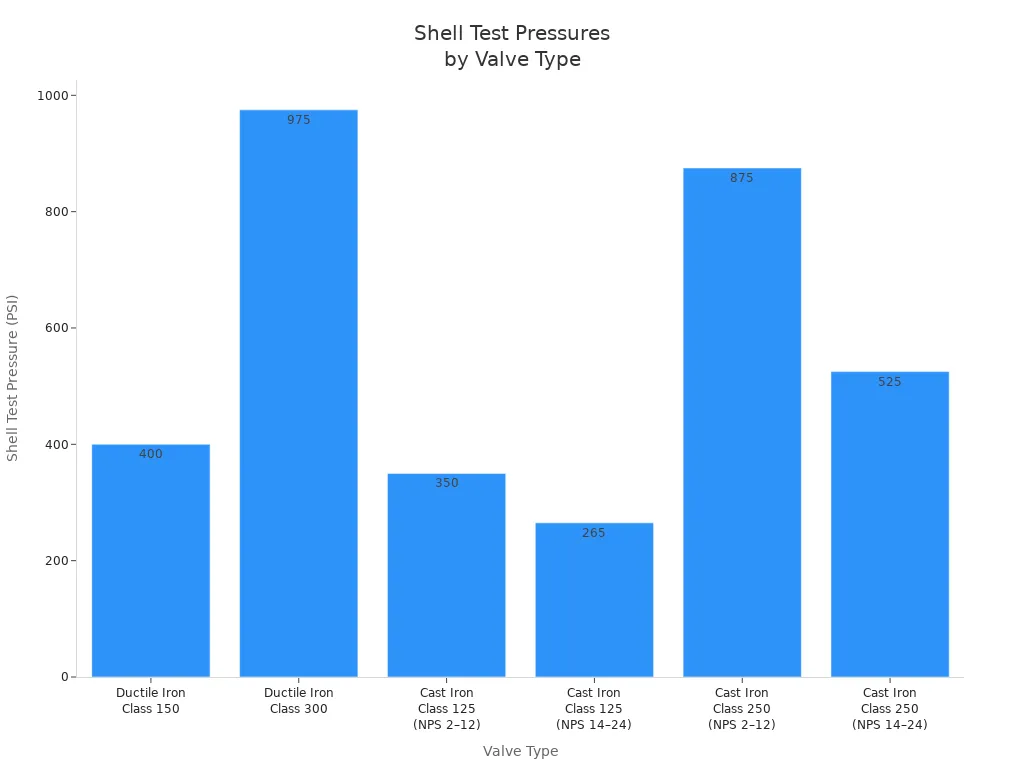
These tests help you find leaks and make sure the valve will not fail in service.
API 6D Testing Standards
You must follow strict rules when you test an api 6d check valve. The standard requires you to check the shell and seat for leaks and strength. You use hydrostatic tests for the shell and seat. The shell test uses 1.5 times the valve’s rated pressure. The seat test uses 1.1 times the rated pressure. If you use the valve in cold service, you must also do cryogenic leakage tests. High-pressure valves need life-cycle testing with 1,000 full-stroke cycles.
You also need to follow quality protocols during manufacturing. These include:
|
Protocol/Standard |
Description |
|---|---|
|
Non-destructive testing |
You check pressure parts for flaws |
|
Hydrostatic testing |
You test the valve with water under pressure |
|
Quality management system |
You follow ISO 9001 for quality |
|
Manufacturing traceability |
You track all materials and processes |
|
Performance testing |
You test the valve at different temperatures and pressures |
These steps make sure every api 6d valve meets high industry standards. You can trust the valve to work in tough pipeline jobs.
Tip: Always check valve api 594 api 6d standards before you choose a valve. Good testing keeps your system safe.
End Connections, Size, and Pressure Range
API 594 Connections and Range
You often see API 594 check valves used in process piping. These valves fit between flanges, making installation easy and saving space. You can choose wafer, lug, or double-flanged designs. Wafer style sits between two pipe flanges. Lug style lets you bolt the valve to the pipe, which helps during maintenance. Double-flanged designs give you strong sealing for high-pressure jobs.
You need to know the size and pressure range for API 594 check valves. The standard covers sizes from 2 inches up to 48 inches. Pressure classes start at 150 PSI and go up to 2500 PSI. You can see this information in the table below:
|
Size Range (inches) |
Pressure Class (PSI) |
|---|---|
|
2 |
150 |
|
48 |
2500 |
Tip: You pick the right check valve size and pressure class based on your system’s needs. Smaller valves work well in tight spaces. Larger valves handle higher flows and pressures.
API 6D Connections and Range
API 6D check valves are made for pipelines that carry oil, gas, or other fluids. You find many end connection options, such as flanged, butt-weld, and compact designs. Flanged connections make installation simple and allow for easy removal. Butt-weld connections give you a strong, leak-proof joint, which is important for high-pressure pipelines.
You can select API 6D check valves in sizes from 2 inches to 48 inches. Pressure ratings range from 150LB to 2500LB. The table below shows these options:
|
Size Availability |
Pressure Ratings |
End Connection Options |
|---|---|---|
|
2 inch to 48 inch |
150LB to 2500LB |
Various options |
You match the end connection and size to your pipeline requirements. API 6D valves give you flexibility for different installation needs and pressure demands.
Note: Always check the connection type, size, and pressure rating before you choose a valve. This helps you avoid problems and keeps your system safe.
Typical Applications and Industry Use Cases

LIANGGU VALVE Check Valve Applications
LIANGGU VALVE check valves are used in many industries. These valves help control flow and protect machines. The table below shows where you find these valves and what they do:
|
Industry |
Application Description |
|---|---|
|
Power |
Used in power stations for hot and high-pressure systems. |
|
Petroleum |
Used in oil extraction, transport, and refining. |
|
Chemical |
Needed for chemical processing and making products. |
|
Gas |
Used in gas distribution and management systems. |
|
Steel |
Used in steel factories and processing plants. |
|
Biological |
Used in medicine and biological work. |
|
Municipal |
Used in city water supply and drainage systems. |
|
Heating |
Used in heating systems for good flow control. |
Tip: You can pick a LIANGGU VALVE check valve for almost any project. These valves are easy to install and work well.
API 594 in Industry
Api 594 check valves are used in places that need to stop backflow and protect pumps. These valves work in systems with different flow rates, pressures, and temperatures. The table below shows common industries and the usual conditions for api 594:
|
Industry |
Operational Conditions |
|---|---|
|
Oil and Gas |
Flow rate, pressure, temperature |
|
Chemical Processing |
Flow rate, pressure, temperature |
|
Water Treatment |
Flow rate, pressure, temperature |
|
Oil Refining |
Flow rate, pressure, temperature |
You can use api 594 check valves in oil refineries, chemical plants, and water treatment centers. These valves help keep your system safe and running well.
API 6D in Industry
Api 6d check valves are used in pipelines that move oil, gas, or other fluids far distances. These valves handle high pressures and big sizes. You often see them in cross-country pipelines, pump stations, and storage terminals. Api 6d valves must pass tough tests, so you can trust them in important jobs. If you need a valve for a pipeline, check if api 6d is the right standard. This helps you follow safety and quality rules for your project.
Note: When you compare check valve api 594 api 6d standards, think about your industry and system needs. Picking the right one keeps your operation safe and reliable.
Selection Guide: Check Valve API 594 API 6D
Matching Standards to Applications
You must pick the right standard for your project. Engineers think about the system type, space, and how it will work. If you have little space or want a light valve, choose API 594. This standard covers wafer and lug type check valves. These valves fit well in oil and gas pipes, chemical plants, and power plants. They can handle high pressure and heat.
If you work with big pipelines or need sealing both ways, pick API 6D. This standard is for pipeline check valves. These valves have low pressure drop and last a long time. You use them in long oil and gas pipelines, refineries, and petrochemical plants. They work well in large, high-pressure jobs.
Here is a table to help you choose:
|
Standard |
Type |
Features |
Applications |
Pressure & Temperature Ratings |
|---|---|---|---|---|
|
API 594 |
Wafer and Lug Type Check Valves |
Small, light, good for tight spaces; includes Swing and Wafer types |
Oil and gas pipelines, chemical plants, power plants |
High-pressure, high-temperature jobs |
|
API 6D |
Pipeline Check Valves |
Seals both ways, low pressure drop, lasts long; made for big pipelines |
Long oil and gas pipelines, refineries, petrochemical plants |
High-pressure, large-scale jobs |
Tip: Always look at your system’s needs before picking a standard. The right choice keeps your system safe and working well.
Choosing LIANGGU VALVE Check Valves
You can count on LIANGGU VALVE for good check valves. The company has many products that meet API 594 and API 6D standards. You can find a valve for any job, from small systems to big pipelines. If you need a small valve for a tight spot, pick wafer or lug type. If you need a strong valve for a pipeline, choose a pipeline check valve.
LIANGGU VALVE can make custom valves for you. You tell them what you need, and their experts help you pick the best valve. You get quality valves that pass tough tests. You also get help with paperwork and fast shipping. The company’s experience helps you get the right valve for your project.
Note: You make your system safer and better when you pick LIANGGU VALVE check valves that fit your job and standard.
You should know the big differences between API 594 and API 6D before picking a check valve. These rules help keep your system safe and working right. The table below shows how each rule helps your system stay safe and follow the rules:
|
Standard |
Description |
|---|---|
|
API 594 |
Makes sure check valves stop backflow and work well in high-pressure places. |
|
API 6D |
Sets rules for pipeline valves that control gas or liquid flow. |
You can count on LIANGGU VALVE for good and custom-made valves. The company uses new ways to make valves, helps write national rules, and sends valves to many countries. When you pick between API 594 and API 6D, think about what your system needs and choose the rule that fits your project best.
FAQ
What is the main difference between API 594 and API 6D check valves?
API 594 is used for check valves in process piping. API 6D is used for valves in pipelines. API 6D needs more tests and paperwork. API 594 is made to be small and close fast.
Can you use an API 594 check valve in a pipeline system?
You should not put API 594 check valves in main pipelines. API 6D check valves are better for pipeline systems. They pass harder tests and follow more safety rules for pipelines.
How do you select the right check valve standard?
You need to think about your system type, pressure, and size. Pick API 594 for process piping. Pick API 6D for pipelines. Always choose the standard that fits your project.
Does LIANGGU VALVE offer custom check valves?
Yes, you can ask LIANGGU VALVE for custom check valves. You tell them what you need. Their experts help you pick the best design, material, and standard for your job.
